


The Malaiyaha (Plantation) community continues to face numerous challenges, among which land and housing rights remain the most pressing. Despite decades of promises, successive governments have failed to provide sustainable and just solutions to these long-standing issues. The current government also appears to lack a clear and comprehensive policy framework to address the matter.
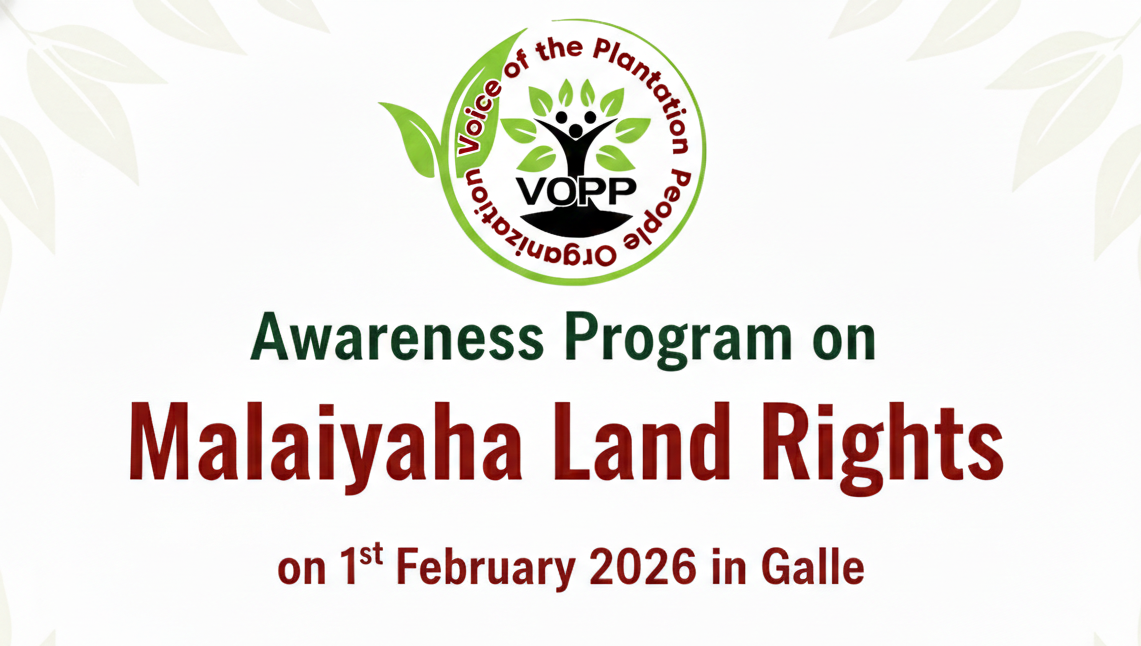
In this context, the Voice of the Plantation People Organization (VOPP) conducted a district-level awareness session on land rights for its district committee members in Galle on 1st February 2026. The session specifically focused on current land-related challenges faced by the Malaiyaha community, people’s experiences, and future actions to address these issues.
During the session, participants engaged in discussions guided by three key questions:
What are your thoughts on the land and housing rights of the Malaiyaha community in Sri Lanka?
Participants expressed that there has been little change over the years. Many feel uncertain about how to resolve land issues and continue to live with hope but without a clear understanding of the proper mechanisms to secure land rights.
What challenges does the Malaiyaha community in Galle District face regarding land and housing rights?
Participants highlighted several ongoing challenges:
After 1994, some families received 7-perch plots multiple times, but no proper deeds or documentation were provided.
Only a few families have received Indian Housing, and even then, without official deeds.
Many families continue to live in line rooms or insecure housing, with poor access to basic facilities.
It was noted that some families in the Thalgaswala Estate, who received 7-perch plots, have been informed by the estate manager that deeds may be provided soon.
How can the land and housing rights of the Malaiyaha people be effectively ensured and protected?
Participants emphasized the urgent need for official deeds for their lands. They called on the government to provide land rights for all Malaiyaha Tamil families. Furthermore, they highlighted the importance of organizing as a community, working collectively, and engaging directly with high-level government authorities to ensure their rights are recognized and protected.
The session concluded with a shared understanding that community organization and sustained advocacy are essential for achieving justice on land and housing rights for the Malaiyaha people in Galle District and across Sri Lanka.


