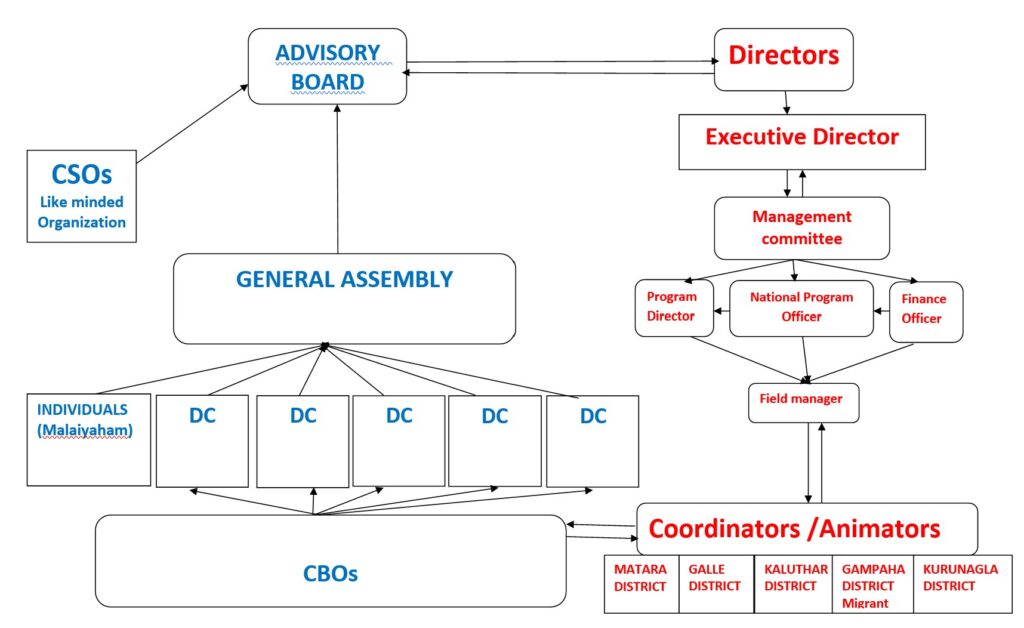
ORGANIZATIONAL STRUCTURE
The Voice of the Plantation People Organization (VOPP) operates through a dual-structure model that balances community-led governance with professional management. This ensures strong grassroots ownership while maintaining strategic leadership and organizational accountability.
VOPP STRUCTURE
Governance and Advisory
• Board of Directors: The final decision-making body on the governance side. It provides overall legal, strategic, and policy oversight to ensure the organization’s integrity, accountability, and alignment with its mission.
• Advisory Board: A guiding body composed of experienced individuals and civil society representatives. It offers advice and strategic direction to the Executive Director, staff team, and Board of Directors. The Advisory Board also helps bridge relationships with civil society allies and brings external perspectives to strengthen the organization’s work.
The Board of Directors and Advisory Board work closely to ensure transparent governance and responsive leadership.
Executive Leadership and Management
• Executive Director: Responsible for the overall leadership and management of VOPP. The Executive Director implements board decisions, leads organizational operations, ensures alignment between strategy and field activities, and supervises staff performance.
Management Committee: Supports the Executive Director and consists of:
• Program Director: Oversees all programmatic activities and holds responsibilities for administration and operational coordination.
• National Program Officer: Leads monitoring and evaluation (M&E), ensuring quality control, learning, and impact assessment across all programs.
• Finance Officer: Manages financial planning, compliance, and reporting.
• Field Manager: Coordinates field activities, supervises district teams, and ensures that programs are effectively implemented on the ground.
Field Operations
• District Coordinators / Animators: Operate in Matara, Galle, Kalutara, Gampaha (Migrant), and Kurunegala districts. They carry out community mobilization, facilitate programs, and act as liaisons between communities and the organization.
Community-Led Structure
• General Assembly: The primary decision-making body on the community side. It consists of:
o District Committees (DCs), also known as District Action Committees
o Individuals from the Malaiyaha community
o Community-Based Organizations (CBOs)
The General Assembly shapes the community development agenda, ensures grassroots participation, and contributes to program direction.
Partnerships and Solidarity
• Like-minded CSOs: Partner with VOPP in joint advocacy, solidarity actions, training, and program implementation to advance community rights and social justice.
Conclusion
VOPP’s structure reflects a community-rooted and professionally managed approach:
• The General Assembly leads decision-making at the grassroots level.
• The Board of Directors is the final authority on governance and policy matters.
• The Advisory Board provides insight and strategic guidance.
• The Executive Director ensures effective leadership and implementation.
This structure enables VOPP to stay accountable to its community, collaborative with partners, and committed to equity and justice for the Malaiyaha people.